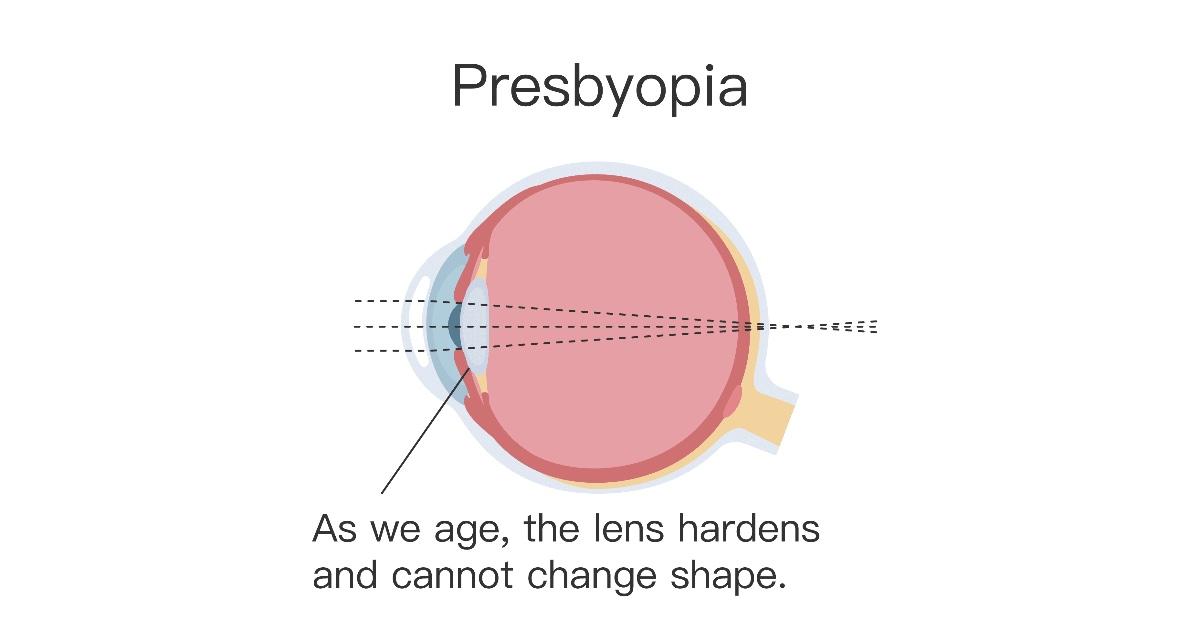
Presbyopia
Symptoms
The main signs and symptoms of presbyopia include:
The need for more light when you’re reading.
Blurred vision at a normal reading distance.
The need to hold reading material at arm’s length.
Headaches from doing close work.
Eye strain, which makes your eyes feel sore or tired.
Diagnosis
Many people over age 40 diagnose presbyopia themselves based on their inability to read clearly at a distance that used to be natural and comfortable. Because the condition comes on gradually over many years, most people don't notice small vision changes and delay seeking professional help until the focusing problems interfere with daily life. Many optometrists joke that patients seek help only when their arms become "too short," unable to hold printed pages far enough away to see clearly.
Presbyopia can be diagnosed by an optometrist, ophthalmologist or physician, who will take a complete medical history to determine the extent of your vision problem. He or she will test your vision by having you read text at a distance that is typically comfortable to you. If the doctor diagnoses presbyopia, he or she will do a test to determine the extent of the focusing problem and the appropriate lens prescription. In this test, the doctor has you look through corrective lenses, and continues to increase the magnification power until the words on the page are clear to you and you are comfortable reading.
Expected duration
Presbyopia cannot be reversed and gets worse as we get older. Vision changes stop around age 65. The only exception is that which occurs when people develop a type of cataract that causes them to be myopic (nearsighted). Such cataracts cause "second sight". Reading vision returns but of course distance vision becomes blurred.
Prevention
Nothing can be done to prevent presbyopia. It is an inevitable part of aging. However, people who do a lot of close visual work, such as working with a computer or intensive reading, may develop presbyopia earlier than others. If you do close work, take a 10-minute break every one to two hours to relieve strain on the eyes. Allow your eyes to focus on objects at a middle or long distance away to give your eyes a rest from close focusing. Be sure to use bright lighting when reading to help your eyes focus.
Treatment
Eyeglasses.
Contact lenses.
Surgeries.
Eyeglasses
Whether or not you’ve been wearing eyeglasses for other vision issues, now may be time to switch to a more comfortable type for your changing eyes. Options include:
Reading glasses (readers). These are ideal for people who don’t have nearsightedness, farsightedness or astigmatism. You can buy readers from the store without a prescription (but it’s a good idea to ask your provider the magnification power you need). You can also choose to get prescription reading glasses tailored to your eyes.
Bifocals. Often prescribed for presbyopia, bifocals are glasses that have two different prescriptions in one spectacle lens. The upper part of the lens has a distance prescription, while the smaller, lower part has a prescription to help you see objects up close.
Trifocals. Trifocals have three lenses: one each for seeing close-up, in-between and far away.
Progressives. Progressives are multifocal lenses, similar to bifocals, but with a more gradual shift between the prescriptions. Many people choose progressives when they don’t want a visible line on their glasses.
Office progressives. These glasses are designed for doing near work in the
Contact lenses
There are a variety of contact lenses that can help you see better with presbyopia. Choose the contacts that help you see most comfortably:
Bifocal contact lenses. A true bifocal lens helps you with just two focal points, usually near and far. They come in soft or hard (gas-permeable) materials.
Multifocal contact lenses. Multifocal lenses are similar to bifocal lenses, and people often use the terms interchangeably. But a multifocal lens can include more than two focal points, including the in-between zone of about three feet. They also come in soft or gas-permeable versions.
Monovision contact lenses. With a set of monovision contacts, one eye wears a lens that helps you see objects at a distance, while the other eye wears a lens that helps with near vision. Your brain gradually adapts to this method, but it can take up to two weeks for it to feel comfortable to you.
Modified monovision contact lenses. With modified monovision, you wear one lens for either near or far vision. In the other eye, you wear a multifocal lens that helps you see at all distances.
Surgeries
Discuss your eye health, family history and lifestyle with your provider before you decide if surgery is right for you. People who only wear readers may find surgery has more risks than rewards for them.
The following three laser procedures correct presbyopia by using monovision (one eye corrected for distance, the other corrected for near vision):
LASIK surgery. Laser in-situ keratomileusis (LASIK) is a popular surgical approach to correct vision in people who are nearsighted, farsighted or have astigmatism.
PRK surgery. You may be a good candidate for a photorefractive keratectomy (PRK) procedure if you have moderate to high nearsightedness, farsightedness and/or astigmatism.
SMILE surgery. With a small-incision lenticule extraction (SMILE) procedure, your surgeon uses a very precise laser to create a disc-shaped piece of tissue inside your cornea that they remove through a small incision